
CEO TRANSITION FRAMEWORK | PILLAR SIX – By Ikky Khan
One of the final responsibilities of a departing CEO is to allow the organisation to develop beyond their leadership.
That responsibility can become difficult when the successor makes an unfamiliar decision, a former colleague asks for help, or the Board calls to discuss a problem the departing leader once handled personally. The instinct to remain useful may be sincere. Acting on it without clear boundaries can draw the organisation back into dependence.
Pillar Five of my CEO Transition Framework examined how authority is transferred visibly. Pillar Six, Step Back with Discipline, asks whether that transfer will be respected after the announcement, particularly when circumstances become uncomfortable.
A departing CEO can care about the organisation, honour longstanding relationships, and make their knowledge available within agreed arrangements. The discipline lies in doing so while allowing the successor to exercise independent judgement and be accountable for the results.
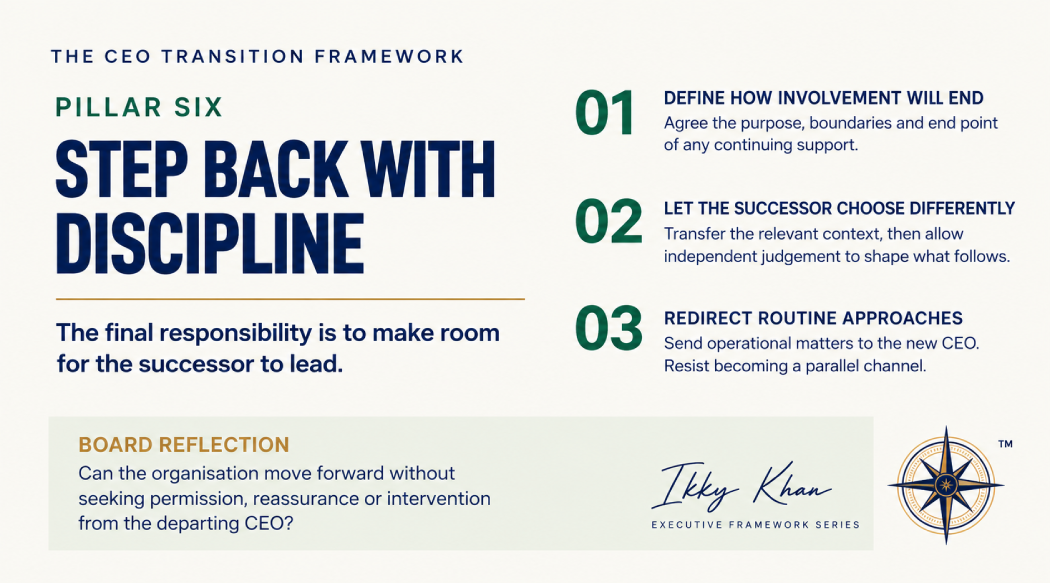
Define how your involvement will end
A transition plan should explain how the outgoing leader’s involvement will conclude. An open invitation to remain available can leave both leaders uncertain about what is expected.
Where continuing support is useful, define the work. There may be a relationship to introduce, a historical decision to explain or a specific project requiring limited assistance. Agree who can request that support, how it will be provided and when the arrangement will be reviewed or completed.
The detail matters because an advisory role can expand through small requests. An explanation becomes a recommendation. A recommendation becomes a meeting with staff. Before long, the predecessor is again coordinating work that belongs to the new leadership team.
Review whether each remaining dependency has a clear owner. Transfer records and contact history so that access to important knowledge does not depend indefinitely on the former CEO answering the telephone.
If support needs to continue, make that a deliberate decision with a defined purpose. An agreed end date alone does not establish a successful exit. What matters is whether the organisation has the capability and information to proceed without routine intervention.
Allow the successor to make different choices
A departing CEO may understand exactly why the organisation adopted a particular structure or entered a particular market. That history deserves to be transferred accurately. It does not settle every future decision.
Imagine a successor reviewing a service model that their predecessor spent years building. They consult customers and staff, examine the economics, and decide that parts of the model should change. The outgoing leader may feel that valuable work is being dismantled.
Before intervening, they should ask whether the concern rests on material information the successor lacks, or on a preference for the approach they themselves chose. Those are different reasons for wanting to remain involved.
Where relevant facts are missing, provide them through the agreed route. Explain the earlier reasoning and its limitations, including circumstances that have since changed. The successor should be able to consider that information without being expected to reproduce the same decision.
This restraint also applies to commentary. A public observation, a private remark to a former colleague or a comparison with past performance may carry more weight than intended. Before offering a view, consider whether it will help the organisation resolve an issue or simply add pressure to defend the past.
For a leader whose identity has become closely tied to the role, this can take conscious effort. Seeking perspective from a peer outside the organisation may help, while respecting confidentiality. The successor should not have to manage the predecessor’s personal adjustment.
Respond to approaches with care and consideration
People will continue to approach a leader they know. Some will want reassurance. Others will seek context or express frustration about a decision. A respectful response can preserve the relationship while reinforcing the new arrangements.
Listen without assuming that you have the full account. Avoid promising to speak to someone, secure a different outcome or resolve the matter personally. Direct operational questions to the person who now holds responsibility and explain any agreed way in which you can contribute background.
The same care is required when the successor asks for help. Clarify whether they want historical context, a sounding board or assistance with a defined task. Keep your contribution within that request. Offering advice does not require taking ownership of the issue.
For routine matters, scheduled conversations can give both leaders a useful boundary. They create space to prepare questions and share context without turning every difficulty into an immediate call to the predecessor.
Stepping back should never mean ignoring a serious concern. Raise it through the appropriate governance or reporting channel, with the urgency the circumstances require. A concern warrants a proper response; it does not automatically restore the former CEO’s authority to direct the organisation.
The Board must respect the separation
Directors influence whether the departing leader can step back successfully. A Board that repeatedly turns to the predecessor for reassurance may sustain the dependence it expects the new CEO to overcome.
The Chair should help maintain the agreed boundaries. Routine questions about current performance belong with the incumbent CEO. Historical context may still be sought where relevant; however, the purpose and route should be clear.
When results disappoint or a difficult decision attracts criticism, Directors need to examine the evidence, expectations and support available to the successor. If corrective action is required, it should follow the Board’s established oversight process. Informally returning responsibility to the predecessor makes it harder to determine who is accountable.
Where the former CEO remains a Director or shareholder, those continuing roles require explicit separation from the executive position they have left. Their involvement should follow the arrangements appropriate to that role.
The Board should also recognise the outgoing leader’s contribution without making the successor’s tenure a continuing comparison. Acknowledging past service and supporting future leadership are compatible responsibilities. Both deserve attention during the transition.
Leave an organisation that can continue
A useful final review asks where the organisation still relies on the departing CEO. Which relationship has not been properly introduced? Which commitment remains undocumented? Which decision continues to return to the former leader because nobody else feels able to own it?
Each answer identifies work to complete. Assign responsibility, provide the missing context and check that the person taking over has what they need. Treat fewer requests for routine help as an expected sign of progress.
Across the six pillars, the responsibility has moved from establishing clear governance and leading with generosity to transferring context, listening carefully and making authority visible. This final pillar requires everyone involved to honour the independence those earlier steps were intended to create.
The Board reflection is straightforward: can the organisation move forward without continuing to seek permission, reassurance or intervention from the departing CEO?
The departing leader has a question to consider as well: am I willing to see the organisation succeed in ways I would not have chosen?
A successor needs room to build relationships, make judgements and carry responsibility. Giving them that room is a practical expression of confidence in the organisation and its future leaders.