
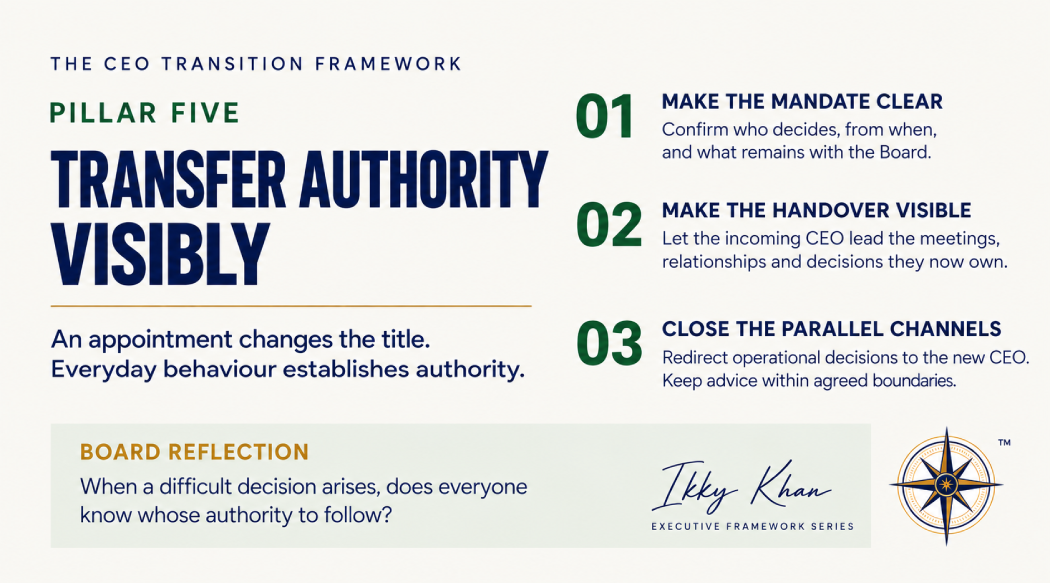
CEO TRANSITION FRAMEWORK | PILLAR FIVE – By Ikky Khan
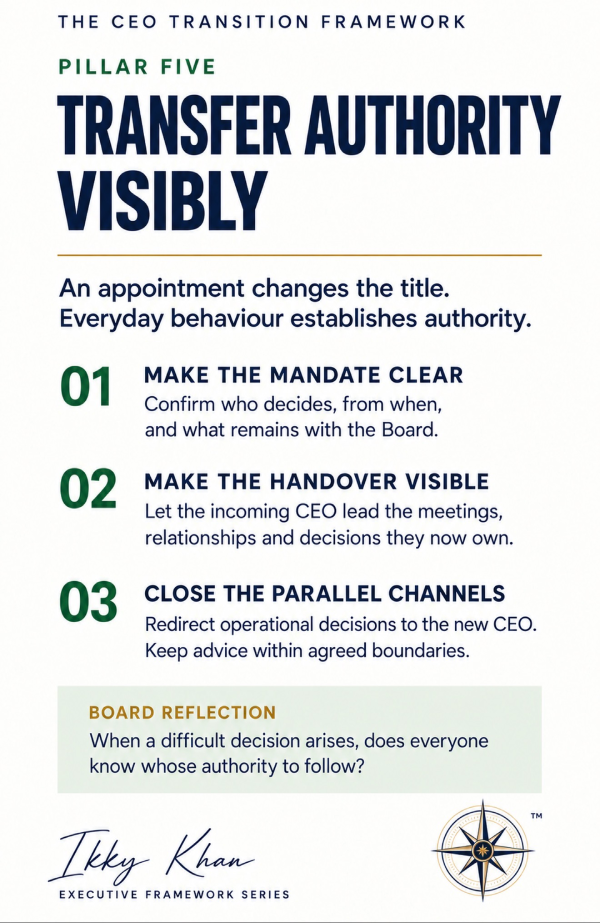
An appointment changes the title. Everyday behaviour establishes authority.
Consider an executive who receives a decision from the incoming CEO, then calls the predecessor to ask whether it is really the right approach. The former CEO offers a different view. The executive delays implementation while the two leaders discuss it.
Even if everyone intended to be helpful, the organisation has received a signal: the new CEO’s decision may still need the former CEO’s approval.
Pillar Four of my CEO Transition Framework examined the discipline of listening before acting. Pillar Five, Transfer Authority Visibly, addresses what must happen around the incoming leader so that they can exercise the responsibility they have accepted.
The handover must be clear in formal arrangements and reinforced through conduct. People need to understand who decides, from when, and how disagreement should be resolved. Otherwise, familiar relationships can continue to determine where decisions are made.
Make the mandate clear
Before the transition takes effect, the Board and both leaders should establish a shared understanding of the incoming CEO’s mandate. That includes the scope of executive authority, matters reserved for the Board, reporting expectations, and the point at which responsibility changes hands.
An overlap period deserves particular attention. If the outgoing CEO remains available for several weeks, people should know whether that role involves advice, introductions, completion of specified work or continuing authority over a defined matter. Availability alone should never be treated as a mandate to direct.
The arrangements also need to respect the responsibilities already delegated to other executives. Transferring authority to a new CEO does not mean drawing every operational decision into the chief executive’s office. It means making accountability clear throughout the organisation.
Translate the agreement into practical arrangements. Update approval permissions, reporting relationships, meeting ownership and access to relevant information. A leader whose mandate has changed but whose access still depends on their predecessor faces an avoidable obstacle.
Communicate the arrangements in language people can use. A manager deciding whether to approve expenditure or escalate a service concern should not have to interpret the relationship between two senior leaders.
Use familiar decisions to check understanding. Ask executives who would authorise them, who should be consulted and where unresolved disagreement would go. Conflicting answers deserve attention before the handover.
Make the handover visible
Authority becomes credible when people see the incoming CEO exercising it with the support of those around them.
The outgoing leader has an influential role here. In meetings with employees, customers and partners, they can explain the transition, acknowledge the new CEO’s responsibility and allow their successor to lead the discussion. Introductions should establish the person to whom future matters belong.
Consider a meeting with a longstanding customer. The predecessor may need to explain the history of a commitment, but the incoming CEO should lead the conversation about future priorities. At its conclusion, the customer should know who owns the relationship and where the next decision will be made.
Small habits matter. Who opens the executive meeting? Who sets the agenda? Who receives the request for a decision? If everyone continues to look towards the former CEO when the conversation becomes difficult, the formal announcement has further work to do.
The incoming CEO also needs to accept the responsibility. Seeking advice can improve judgement, but repeatedly referring decisions back to the predecessor can reinforce uncertainty about who is now accountable.
Close the parallel channels
Personal relationships do not end on the date of a handover. Former colleagues will still speak, and a departing CEO may retain valuable knowledge. The challenge is to prevent those relationships from becoming an alternative route for executive decisions.
A request for context is different from a request to overturn a decision. When someone approaches the predecessor with an operational matter, the response should direct it to the person who now holds responsibility. Where background would help, it can be shared through an agreed process.
Advice should be transparent to the incoming CEO and bounded by the transition arrangements. A continuing advisory role needs a defined purpose, clear access arrangements, and a review point. Otherwise, an informal source of support can gradually become a second executive office.
This discipline must preserve legitimate challenge. Staff still need appropriate ways to raise concerns, report misconduct and escalate serious risks. Closing parallel decision channels must never obstruct those pathways or insulate the incoming CEO from scrutiny.
The distinction is practical: challenge should reach the appropriate forum for consideration. It should not depend on finding a former leader willing to provide a more favourable answer.
The Board must be consistent
The Board’s conduct can strengthen or weaken the authority it has conferred. Directors who publicly endorse the incoming CEO, however, privately seek operational instructions from the predecessor create ambiguity that the organisation will eventually encounter.
The Chair should establish clear expectations for contact with both leaders. Where directors seek historical context from the departing CEO, that contact should serve an agreed purpose and avoid creating competing instructions for management.
If the former CEO remains a director, their continuing Board responsibilities should be distinguished from executive authority. Concerns belong within the appropriate governance process. Previous executive tenure does not, by itself, confer continuing permission to direct staff.
Supporting the successor also requires room for legitimate differences in judgement. An incoming CEO may choose a different approach after considering the available evidence. Directors should assess that choice against the organisation’s objectives, risks and agreed mandate.
Where the Board has concerns about performance, it should address them directly with the CEO through established oversight arrangements. Reintroducing the predecessor as an informal decision maker leaves accountability uncertain precisely when greater clarity is needed.
Test the transfer through real decisions
A useful transition review examines what happens when authority is tested.
Trace a significant decision from the initial request to implementation. Was it made by the person with the relevant delegation? Did staff understand the escalation route? Was it reopened through an informal conversation? Did anyone delay because they were waiting for reassurance from the former CEO?
These questions provide a clearer picture than asking whether the handover announcement was well received. Repeated referrals backwards, conflicting instructions or unexplained delays are reasons to examine the arrangements and correct them promptly.
The test applies externally as well. Customers and partners should know who can make commitments and how those commitments will be authorised. Where an old relationship continues to bypass the new arrangements, both leaders should reinforce the agreed route.
The Board reflection for this pillar is therefore straightforward: when a difficult decision arises, does everyone know whose authority to follow?
That clarity gives the incoming CEO a fair opportunity to lead and gives the Board a sound basis for holding them accountable.
Pillar Six, Step Back with Discipline, will examine the responsibility that follows for the departing leader. A visible transfer of authority prepares the organisation to move forward with confidence in who now leads it.