
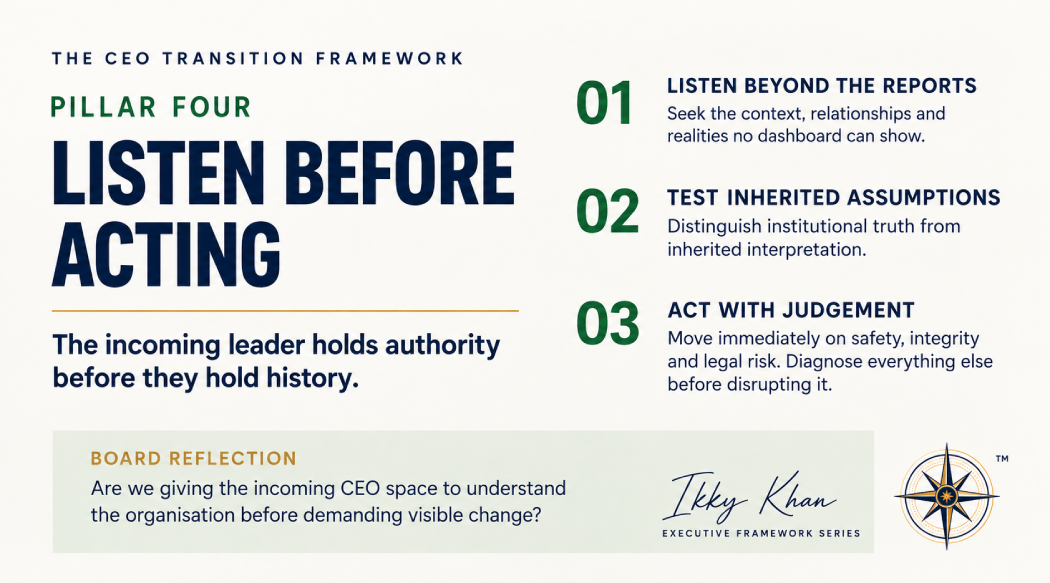
CEO Transition Framework infographic about listening before acting. – By Ikky Khan
An incoming CEO is rarely short of advice. Before they have settled into the role, people may already be explaining which departments need restructuring, which relationships need repairing, and which decisions the previous leader should have made.
The expectation to demonstrate progress can be considerable. The Board wants confidence in its appointment. Employees want to know what will change. Customers and partners want reassurance that their priorities will receive attention.
In that environment, visible action can feel like the clearest way to establish credibility. There is, however, an important reality to recognise: the incoming leader holds authority before they hold history.
Pillar Three of my CEO Transition Framework examined the responsibility to transfer context. Pillar Four, Listen Before Acting, asks how the incoming CEO should test that context and build an informed understanding of the organisation.
Listening is disciplined inquiry. It requires purpose, curiosity and a willingness to discover that the first explanation was incomplete.
Listen beyond the reports
Board papers and executive briefings provide an essential starting point. They also compress complicated situations into a form that can be reviewed and discussed. A new CEO needs to understand what has been lost in that compression.
Consider a service team that consistently meets its delivery targets. The dashboard presents a reassuring picture. A conversation with the people doing the work might reveal that performance depends on manual corrections, repeated customer calls, and the knowledge of two experienced employees.
The reported result may be accurate, while the operating model beneath it is fragile. Changing the team structure before understanding those dependencies could remove the very capability keeping the service functioning.
Ask people to walk through how work actually gets done. Where do they encounter delays? What do they routinely correct? Which concern has been raised several times without reaching a decision?
These conversations should extend beyond the executive team. Include people across locations, shifts and levels of responsibility, together with customers and relevant partners. Look for whose experience is missing from the formal account.
The aim is to build a fuller picture of performance and the conditions sustaining it.
Test the assumptions, including your own
Every organisation has explanations that have become familiar through repetition. A team is described as resistant. A market is considered unattractive. A customer is regarded as difficult. Sometimes those assessments remain sound. Sometimes circumstances have changed, or the explanation was never properly examined.
An incoming CEO should treat inherited interpretations as propositions to explore.
Ask what people believe must be protected and why. What has served the organisation well? Which assumptions no longer hold? Where does the reported position differ from operational experience? What would employees or customers change first if they could?
Use a consistent core of questions across conversations. This makes it easier to identify recurring themes and understand why accounts differ. A single persuasive conversation should not settle a judgement about a person or a function.
When accounts conflict, return to specific events and available evidence. Distinguish what someone directly observed from what they inferred or heard elsewhere. This protects the inquiry from becoming a contest between the most confident voices.
The same scrutiny needs to be applied to the new CEO’s own instincts. Experience is valuable, however,
a solution that worked in a previous organisation may depend on conditions that do not exist here.
Ask yourself what evidence would cause you to revise your initial view. Seek out someone who can make a credible case against it. Listening loses much of its value when its purpose becomes confirming a decision already made.
Make candour possible
The quality of what a CEO hears depends partly on how safe and worthwhile people believe the conversation will be.
An employee may speak cautiously because an earlier concern damaged a relationship. A manager may fear that acknowledging a weakness will be interpreted as admitting incompetence. Others may simply have learnt that senior leaders welcome suggestions only when they fit the preferred explanation.
A new CEO cannot remove that history through a single invitation to speak openly. They can begin to establish a different experience through their responses.
Allow people to finish. Ask for examples before drawing conclusions. Acknowledge uncertainty where it exists. Make clear how sensitive concerns will be handled and provide an appropriate route where an open meeting is unsuitable.
Pay attention to your reaction when someone challenges your interpretation. Defensiveness can close a conversation that began with apparent openness.
Follow through afterwards. People should know that their contribution was considered, even where their preferred solution is not adopted. Explaining what has been learnt, what needs further examination, and when a decision will be made gives listening a visible purpose.
Be careful about promises made during these conversations. Listening to a proposal does not commit the organisation to implementing it. Explain that competing needs will have to be weighed, and keep any commitments you do make.
Act with judgement while understanding develops
Listening before acting requires judgement about urgency. The condition of the organisation should determine the pace.
Immediate threats to safety, integrity, solvency or lawful operations require a prompt response, with appropriate specialist advice where needed. An incoming CEO may have to put protections in place while the fuller assessment continues.
Other decisions allow more room for inquiry. Major changes to structure, strategy or leadership deserve an understanding of their dependencies and likely consequences. The desire to demonstrate momentum is an insufficient reason to rush them.
Where the evidence remains incomplete, consider a limited, reversible intervention. Test a proposed improvement in one part of the operation, define what success would look like, and examine the result before extending it.
Listening should also have a timetable. Identify the questions that must be answered, the evidence required and the decisions that will follow. Explain any delay and set a point for review.
As the picture develops, distinguish what deserves protection, what requires repair, what should stop and what needs to be built. Give credit to existing strengths as readily as you identify weaknesses. People need to see that the new CEO understands what is already working.
The Board must make room for understanding
Directors have a significant influence on the quality of an incoming CEO’s listening. Expectations set at appointment can either support careful inquiry or create pressure for premature certainty.
Early reviews should examine what the CEO has learnt, which assumptions have changed and where immediate action has been necessary. Ask what remains uncertain and how that uncertainty will be resolved.
The Board should also be willing to hear that its own understanding was incomplete. Inviting a fresh perspective carries little value if the new CEO is discouraged from questioning established conclusions.
Listening earns its place through the decisions it improves. The transition should progressively reveal a leader who can explain the organisation’s strengths, recognise its vulnerabilities and act with a clear sense of consequence.
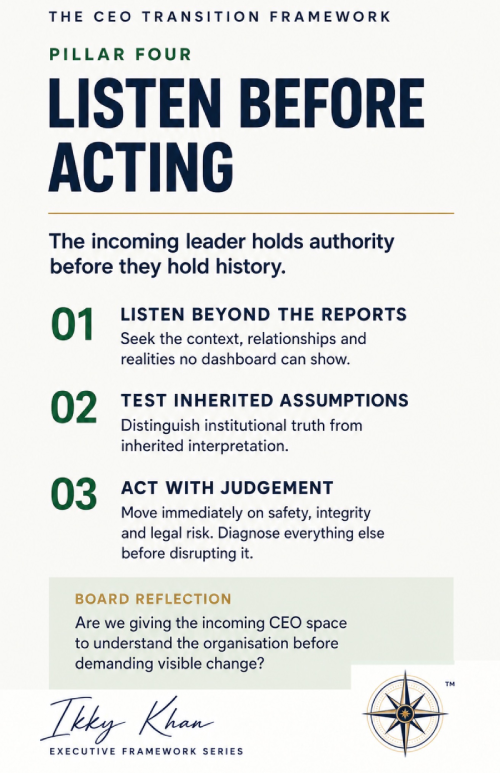
The question for the Board is simple: are we giving the incoming CEO space to understand the organisation before demanding visible change?
A leader who takes that responsibility seriously gives people a reason to believe that the changes ahead have been thought through.