
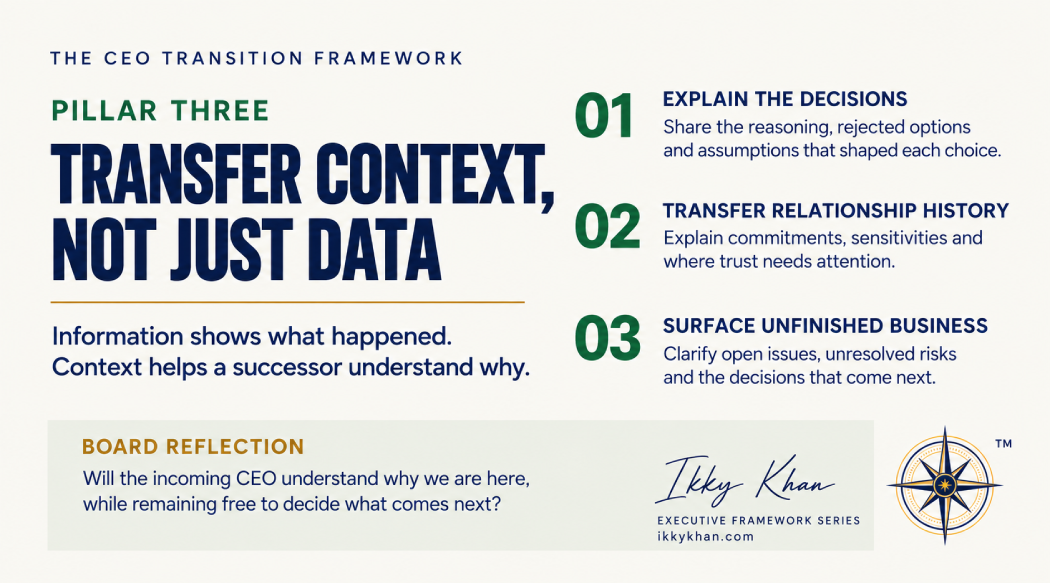
CEO TRANSITION FRAMEWORK | PILLAR THREE – By Ikky Khan
An incoming CEO can read the financial statements, study the strategy, and work through the risk register. They may quickly learn which projects are late, which contracts matter and where performance is below plan. They can still have little understanding of how the organisation arrived there.
A stalled initiative may carry the memory of a previous failure. A cautious executive may know something about a stakeholder that the briefing papers never explain. A decision that appears difficult to justify today may have been reasonable under circumstances that have since changed.
Understanding that history gives a successor a stronger basis for deciding what comes next.
This is the purpose of the third pillar of my CEO Transition Framework: Transfer Context, Not Just Data.
Information tells a successor what the organisation has done. Context helps them understand what the organisation has lived through.
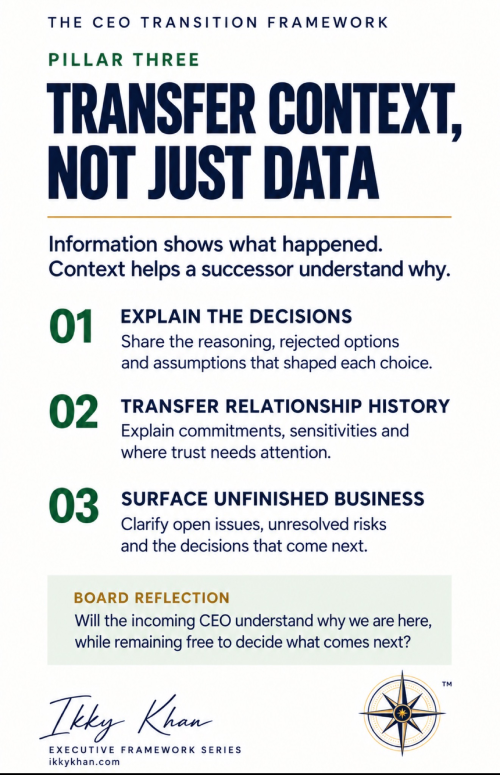
Explain the reasoning behind the decisions
The decision recorded in a Board minute is the conclusion of a discussion. An incoming CEO also needs to understand the reasoning that produced it.
What alternatives were considered? Which constraints shaped the choice? Where did the executive team disagree? What assumptions were expected to hold, and which are now becoming questionable?
Consider a business that deferred expansion into a promising market. The papers may record a decision to wait. The fuller explanation might involve limited operational capacity, an unresolved partner concern or a funding arrangement that would have exposed the organisation to unacceptable pressure.
Each explanation suggests a different next step. The successor may need to build capacity, reassess a relationship or secure different funding. Without that context, they risk repeating work already undertaken or misreading caution as a lack of ambition.
The same discipline should apply to failed initiatives. Explain what went wrong, what the organisation learnt and which weaknesses remain. A successor needs an honest account of the limits of earlier decisions.
A useful handover should make the reasoning visible, including the doubts that remained after the decision was made. It should also identify what would justify reopening the matter. This gives the new CEO something they can test against current conditions.
Pass on the history held in relationships
Stakeholder lists tell an incoming CEO whom to meet. They rarely explain what those people are waiting to hear.
A major customer may still be judging whether the organisation has recovered from a service failure. A government stakeholder may expect an update on an earlier undertaking. Employees may remember assurances about a restructure that were never fulfilled.
These histories can influence how the first conversation with a new CEO is received.
The handover should explain significant commitments, previous difficulties and the work required to build or restore confidence. Introductions become more useful when the successor understands why the relationship matters and what needs attention.
The same care applies within the organisation. An experienced manager or longstanding employee may carry considerable informal trust despite having a modest place on the organisational chart. Knowing who colleagues turn to can help a new CEO understand how information and confidence travel through the business.
This requires care with language. Describe events, commitments, and observable behaviour. Personal grievances and convenient labels can unfairly shape a successor’s view of people they have yet to meet.
Bring unfinished business into view
Some of the most consequential matters in a transition sit between formal decisions.
A negotiation may be advanced without being concluded. Two executives may have different understandings of who owns a difficult issue. A proposed change may depend on capacity that has not yet been secured. An assurance given in conversation may have created an expectation that nobody has recorded.
These matters deserve explicit attention because a change of CEO does not remove the expectations surrounding them.
For each significant open issue, the successor should understand its current position, the people involved, the next decision required and the consequences of delay. Be clear about what has been agreed, what remains a proposal and what needs verification.
The uncomfortable matters belong in that discussion too. Where has confidence weakened? Which risks have been tolerated while a solution is developed? What problem has repeatedly returned despite assurances that it was resolved?
Candid answers give the incoming CEO a chance to act before uncertainty turns into surprise.
Give context a practical form
Context needs a place in the transition plan. Leaving it to an unstructured conversation in the outgoing CEO’s final week makes its quality depend too heavily on memory and goodwill.
I would organise the handover around the few matters most likely to affect the successor’s early decisions. For each, provide the relevant documents alongside a concise account of the history, reasoning, commitments, remaining uncertainties, and immediate choices.
Then make time to discuss them. A successor should be able to question the account, follow an unexpected thread and return to a matter after reviewing the underlying material.
The Board should help ensure that important knowledge can be accessed even where the departure is sudden or the relationship with the outgoing CEO is difficult. Relevant executives, Board records and established decision logs can provide other parts of the picture. Good transition preparation begins while the knowledge is still being created.
Sensitive information needs appropriate handling, with access limited to those who require it for their responsibilities. A disciplined handover can preserve necessary context without turning private conversations into an indiscriminate archive.
Preserve the successor’s freedom to lead
Every account of an organisation reflects a perspective. The outgoing CEO’s interpretation deserves careful attention, alongside the views of the Board, executive team, employees and relevant stakeholders.
Where accounts differ, the difference itself may be useful. It can reveal an unresolved disagreement, a gap in communication or an assumption that has gone unchallenged.
The incoming CEO should have room to examine those differences and form an independent judgement. Historical constraints may have eased. Stakeholder expectations may have moved. A choice that was sound two years ago may deserve a different answer today.
The outgoing CEO’s responsibility is to explain their judgement openly and accept that a successor may reach another conclusion. The Board should support that freedom while expecting the new CEO to understand the consequences of change.
A useful test is whether the successor can explain why the organisation stands where it does, what remains uncertain and which decisions now require their attention.
That is the understanding a good handover should provide.
Transfer the context fully. Leave the judgement with the person who now has to lead.