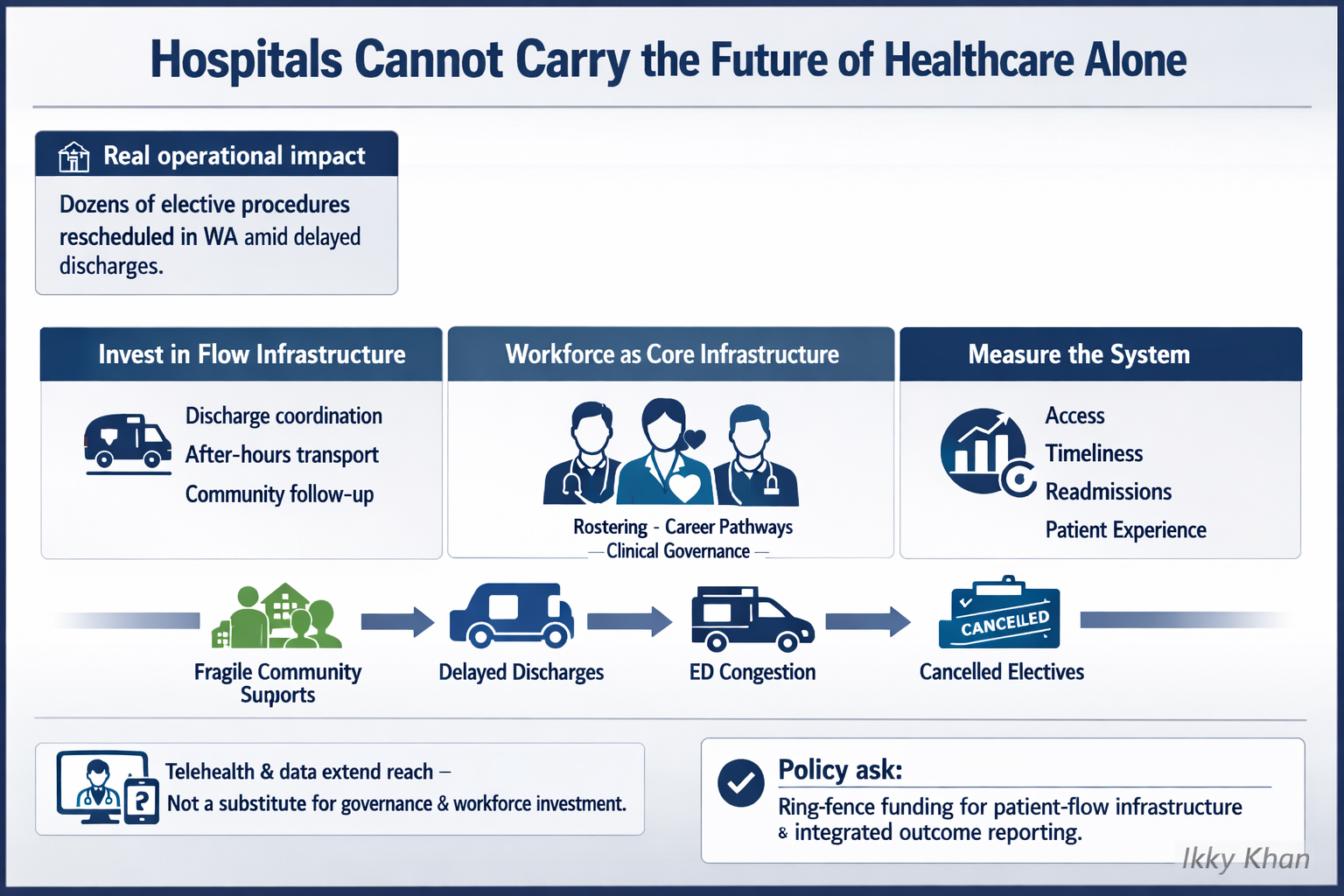

Last winter’s elective – surgery cancellations in Western Australia were not an isolated operational hiccup; they were a symptom.
Health services rescheduled dozens of procedures over consecutive days to free capacity as hospitals coped with exceptional demand and delayed discharges.
Hospitals remain indispensable centres of acute expertise, trauma care and complex surgery. However, treating them as the default absorber of every system pressure is no longer sustainable.
Across the country, structural forces; an ageing population, rising patient acuity, workforce shortages and growing expectations for care closer to home are compounding rather than cycling away.
Pressure in modern health systems does not vanish, it migrates. When community supports, discharge pathways and non – emergency transport are fragile, emergency departments swell, elective lists are deferred, and clinicians face avoidable strain.
The WA example shows how quickly operational failure in one domain becomes a system – wide problem.
What must change is not rhetoric, but design. The future of sustainable care requires three practical shifts:
• Invest in flow infrastructure. Reliable discharge coordination, after – hours transport and community follow – up are capacity multipliers, not discretionary costs.
• Treat workforce sustainability as core infrastructure. Predictable rostering, career pathways and clinical governance for non – hospital clinicians reduce burnout and preserve capability.
• Measure the system, not just the hospital. Track outcomes across the patient journey; access, timeliness, readmissions and patient experience, and hold integrated partnerships accountable.
Technology will extend reach. Telehealth, remote monitoring and data integration matter. However, technology without governance and workforce investment will not resolve structural strain.
This is a human problem.
Behind every cancelled procedure and every delayed discharge are patients, families and clinicians bearing the consequences. Policy and investment must reflect that reality: hospitals must be protected, but the system that protects hospitals must be strengthened.
A clear policy ask: ring – fence targeted funding for patient‑flow infrastructure (transport, discharge coordination, community follow – up) and require integrated outcome reporting across hospital and non‑hospital providers. That single, measurable change would reduce avoidable elective cancellations and preserve acute capacity.
If we accept that hospitals cannot carry the future of healthcare alone, the choice is straightforward: rebalance investment and accountability across the whole system,
Now, deliberately, structurally, and with urgency.