
There are certain organisations within society whose importance only becomes fully visible when they are placed under strain.
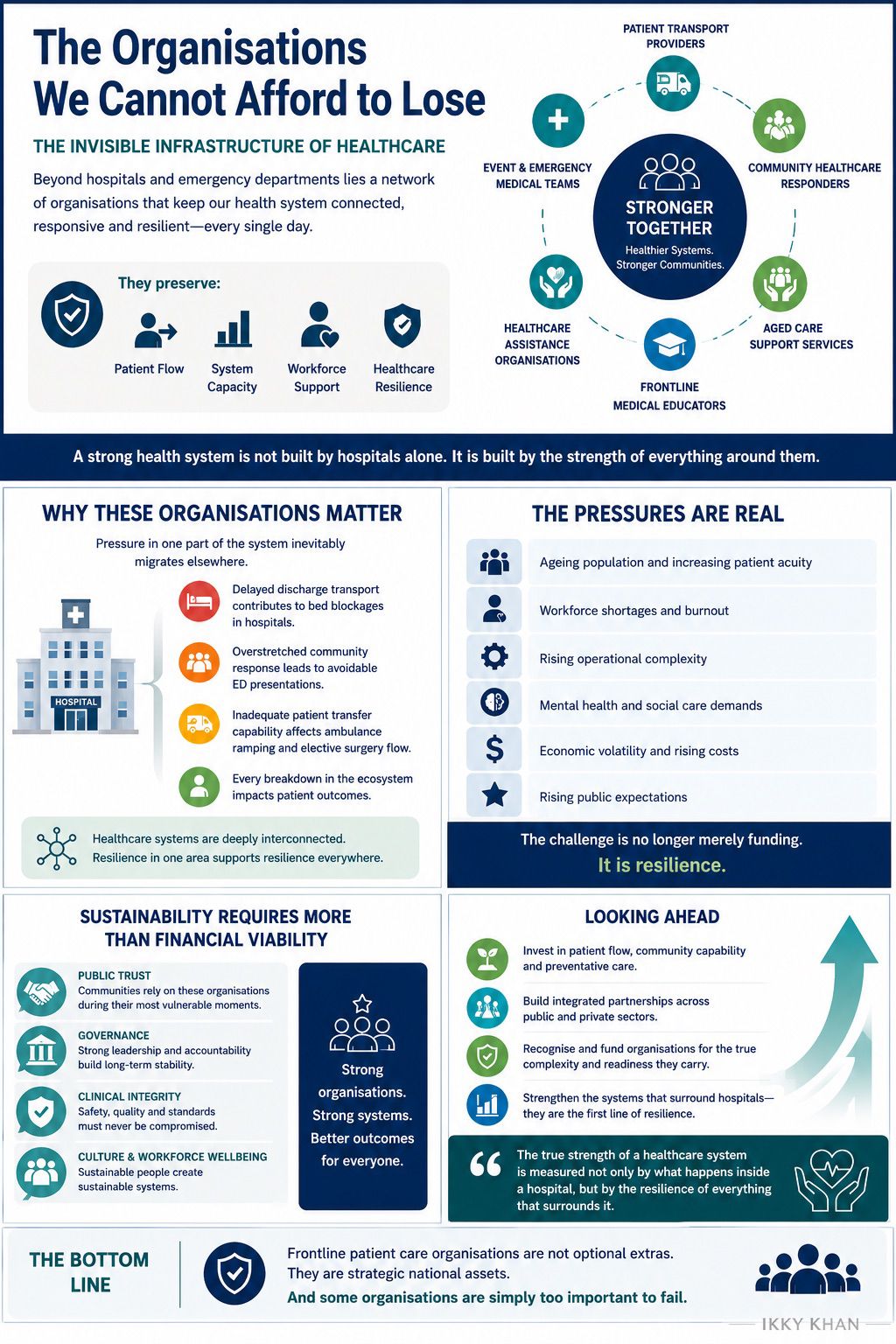
Emergency services, patient transport providers, community responders, aged care support organisations, frontline educators, and healthcare assistance networks rarely command the same public attention as hospitals themselves. Yet every day, across cities, regional communities, and rural corridors, they form part of the invisible infrastructure that quietly keeps healthcare systems functioning.
Without them, the pressure placed upon hospitals, ambulance services, emergency departments, and clinicians would become unsustainable.
These organisations are not peripheral to healthcare delivery. They are truly foundational to it.
Over the coming decade, Australia, like many developed nations, will face extraordinary pressure across its healthcare system. Population growth, an ageing demographic, increasing patient acuity, workforce shortages, mental health demands, and growing operational complexity will all converge simultaneously.
At the same time, public expectations of healthcare accessibility and responsiveness will continue to rise. The challenge is no longer merely one of funding, but of resilience.
The question confronting healthcare leaders, governments, Boards, and communities alike is this: “whether the systems surrounding frontline care are being strengthened quickly enough to absorb the demands that are already emerging?“
Much of the national conversation around healthcare quite rightly focuses on hospitals, emergency departments, and ambulance response times. However, far less attention is given to the ecosystem that exists around those services; the organisations that prevent additional strain from reaching hospital doors in the first place.
Non – emergency patient transport providers, community healthcare organisations, hospital support services, event medical teams, and healthcare educators all contribute to the continuity of patient care in ways that are often under – appreciated.
Their role extends beyond logistics. They preserve flow. They preserve access. They preserve capacity.
And increasingly, they preserve safety.
A delayed discharge transport can contribute to bed blockages inside hospitals. An overstretched community response system can result in avoidable emergency department presentations. Inadequate patient transfer capability can affect ambulance ramping, elective surgery flow, and patient outcomes.
Healthcare systems are deeply interconnected.
Pressure in one area inevitably migrates elsewhere. This is why the long-term sustainability of patient care organisations matters so profoundly.
These organisations are frequently expected to operate within highly compressed financial environments while simultaneously maintaining clinical standards, workforce capability, operational readiness, governance obligations, and round-the-clock service continuity.
That balancing act becomes increasingly difficult in periods of economic volatility, labour shortages, and rising operational costs.
Yet despite these pressures, many frontline patient care organisations continue to demonstrate remarkable resilience and commitment to service delivery.
Behind every patient transfer, every community response, every overnight transport, every medical support deployment, and every educational session delivered to future clinicians are people carrying significant operational and emotional responsibility.
The healthcare sector often speaks about workforce fatigue in hospitals and emergency departments, and rightly so. However, the same pressures are being experienced across the broader patient care ecosystem.
Sustainable healthcare requires sustainable people. That reality must remain central to future planning. Another challenge facing the sector is the growing complexity of modern patient care itself.
Healthcare delivery is no longer confined to traditional hospital settings. Increasingly, care is moving outward into homes, communities, virtual environments, and decentralised models of support. Hospital avoidance programs, community-based interventions, telehealth – enabled care, and preventative response frameworks are all becoming more prominent within modern healthcare systems.
This transition presents enormous opportunity.
But it also requires capable, clinically governed organisations that can operate safely and effectively outside traditional hospital environments.
The future of healthcare will not be built solely through expanding hospitals. It will be built through strengthening the systems that surround them. That includes investing in patient flow, workforce development, community capability, preventative care, and integrated partnerships between public and private providers.
Importantly, discussions around sustainability must also extend beyond financial viability alone.
Public trust matters. Governance matters.
Clinical integrity matters. Culture matters.
Organisations entrusted with patient care responsibilities carry obligations that extend far beyond commercial performance.
Communities place extraordinary trust in healthcare providers during moments of vulnerability, uncertainty, and crisis.
That trust must never be treated lightly.
Strong governance, ethical leadership, workforce wellbeing, and operational accountability are not optional extras within healthcare. They are essential pillars of long-term organisational survival.
And survival matters.
Because when patient care organisations weaken, the consequences are rarely isolated to a single provider.
The impact ripples outward across hospitals, ambulance systems, aged care networks, regional communities, clinicians, and ultimately patients themselves.
Healthcare resilience is therefore not merely a hospital issue.
It is a national systems issue.
The organisations operating quietly between emergency response and definitive care are often the very mechanisms preventing broader system overload.
They deserve recognition not simply for the services they provide, but for the stabilising role they play within healthcare itself.
As Australia continues navigating the growing complexity of healthcare delivery, one truth is becoming increasingly clear:
The sustainability of frontline patient care infrastructure will become one of the defining leadership and policy challenges of the next decade.
The organisations working within this space cannot simply be viewed as operational necessities. They must be recognised as strategic national assets.
Because ultimately, the true strength of a healthcare system is not measured solely by what happens inside a hospital. It is measured by the resilience of everything surrounding it.
And some organisations are simply too important to fail.