

Most boards govern organisations. Exceptional boards shape their future.
Every board is expected to meet its statutory obligations. It must approve budgets, review financial performance, oversee risk and ensure compliance with its fiduciary responsibilities.
These responsibilities matter. They are fundamental to good governance. But they are also the baseline.
What distinguishes a truly exceptional board is not the work it must do, but the quality of stewardship it brings to every decision. Great boards look beyond supervising the present. They shape the organisation’s future, strengthen its resilience and create the conditions for sustainable success.
Having observed boards across healthcare, government, not – for – profit, and commercial sectors, I have found that the strongest consistently demonstrate a number of defining characteristics.
These behaviours are not accidental. They are deliberate, disciplined and deeply embedded in how outstanding directors think, inquire and govern.
Relentless Curiosity
High – performing boards are defined by their intellectual curiosity. They do not seek reassurance; they seek understanding. Rather than asking whether everything is on track, they ask what could derail success. Instead of accepting positive reports at face value, they challenge assumptions, explore alternative interpretations and invite dissenting views.
This curiosity is never adversarial. It is structured, purposeful and grounded in respect. The objective is not to expose management errors but to strengthen the quality of decision-making.
The most dangerous risks are often those that no one believes exist. Curiosity is the board’s earliest warning system.
Boards that cultivate this discipline consistently identify issues sooner, understand complexity more deeply, and make better – informed decisions.
Curiosity is not simply a personality trait. It is a governance capability.
Psychological Safety
Many governance failures begin long before they appear in financial statements or regulatory findings. They begin when executives stop speaking openly.
When leaders fear embarrassment, criticism, or political consequences, information becomes filtered before it reaches the boardroom. By the time directors see the full picture, risks have compounded and opportunities have been lost.
Outstanding boards create an environment where truth travels quickly. Executives feel safe presenting uncertainty alongside confidence. Bad news is not punished, but valued. Alternative viewpoints are encouraged. Constructive disagreement is treated as a strategic asset rather than a threat.
Psychological safety is not about comfort. It is about candour.
The quality of governance is directly influenced by the quality of information a board receives. Great directors understand that culture determines information flow, and information flow determines decision quality.
Strategic Discipline
Many boards unintentionally drift into operational detail. Agendas become crowded with updates and reports that consume time without shaping the organisation’s future. Governance becomes busy rather than strategic.
The strongest boards resist this gravitational pull. They remain anchored to the questions that only directors can answer.
- Where is the organisation heading?
- What capabilities will it require five years from now?
- What emerging risks exist beyond today’s reporting cycle?
- How resilient is the organisation if current assumptions prove incorrect?
This discipline allows management to lead the business while the board governs its trajectory.
Strategic focus is not simply a meeting agenda item. It is a mindset.
A Constructive Partnership with the Chief Executive Officer
The relationship between a Board and its Chief Executive is one of the most important in any organisation.
When it becomes dysfunctional, governance becomes unstable. When it becomes overly loyal, accountability weakens. When it becomes adversarial, performance suffers.
Exceptional boards achieve the right balance. They challenge their Chief Executive while supporting them. They hold them accountable without becoming operational. They provide counsel without taking control. They understand that their role is not to manage the organisation, but to ensure it is exceptionally led.
The strongest Chief Executives welcome thoughtful challenge, not because it is comfortable, but because it produces better decisions.
Great boards create the conditions for that challenge to remain constructive, consistent and grounded in shared purpose.
Governance Maturity
Immature boards often judge organisational performance primarily through financial outcomes. Mature boards recognise that financial results are usually lagging indicators, reflecting deeper organisational conditions that have been developing for months or even years.
They examine culture, leadership capability, succession planning, stakeholder confidence, workforce engagement and organisational trust. These are not soft measures. They are leading indicators of future performance.
Mature boards understand that governance is not simply about protecting value. It is equally about creating it.
Risk oversight and value creation are not competing priorities. They are complementary responsibilities.
Rather than governing consequences, exceptional boards govern the conditions that produce sustainable success.
Continuous Learning
The governance environment continues to evolve at an extraordinary pace. Regulatory expectations shift. Technology reshapes industries. Artificial intelligence is transforming decision-making. Cybersecurity threats continue to accelerate. Stakeholder expectations become increasingly complex.
Boards that stop learning inevitably fall behind the environments they are expected to govern.
The best Directors remain students of governance throughout their careers. They seek diverse perspectives, invest in education and challenge their own assumptions as readily as they challenge management’s.
Continuous learning is not optional. It is a fiduciary responsibility.
Humility
Experience matters. Wisdom requires humility.
Exceptional Directors understand that no individual possesses every answer. They ask better questions, invite expertise into the room and encourage robust discussion before important decisions are made.
Confidence without humility creates blind spots.
Humility combined with experience creates stronger governance.
The most effective boards understand that their greatest strength lies not in individual brilliance, but in collective intelligence.
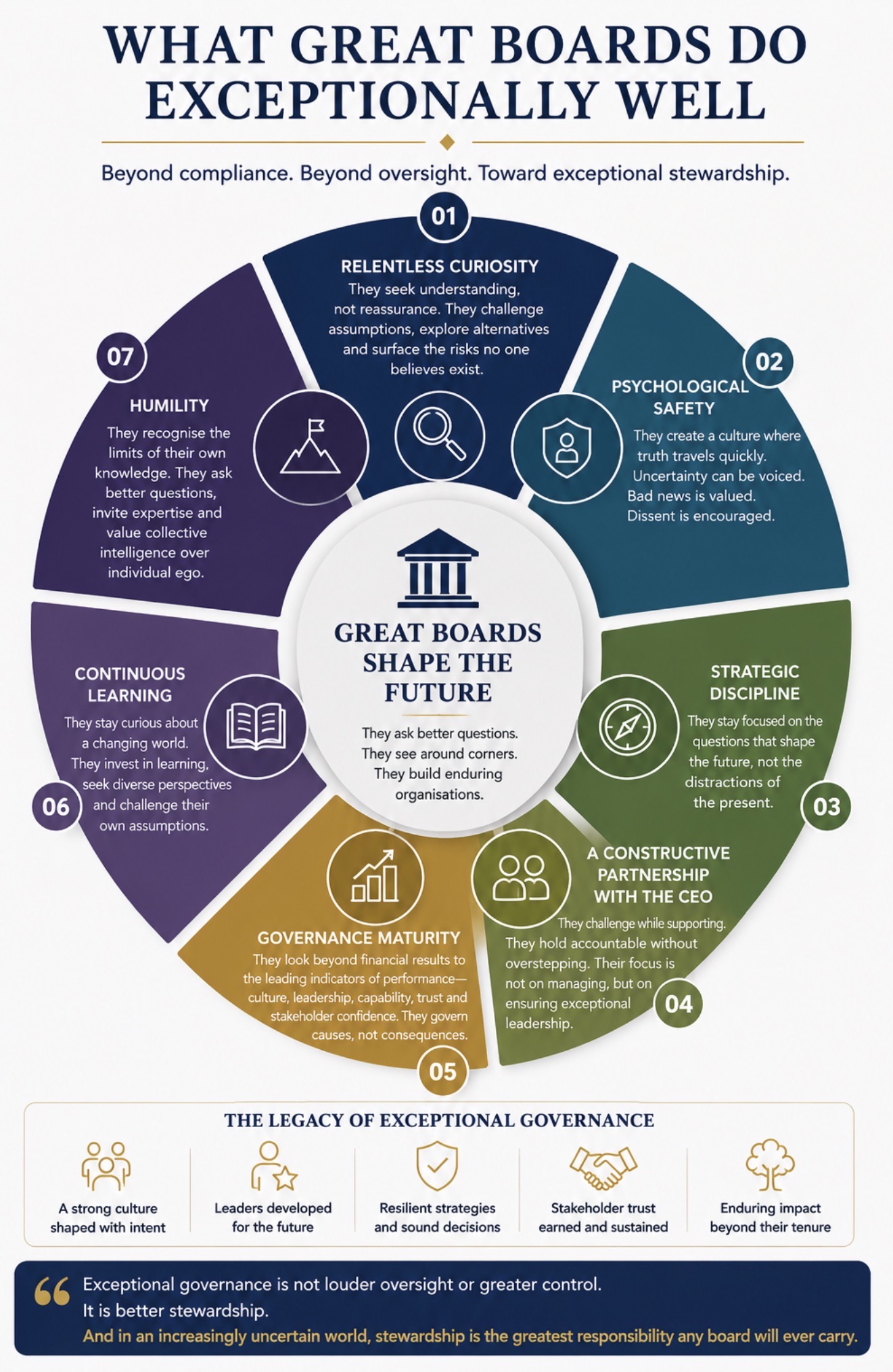
The Legacy of Exceptional Governance
Ultimately, great Boards do not measure their legacy by the number of meetings they attended or the resolutions they passed.
Their legacy is measured by the strength of the organisation they leave behind.
Long after Directors complete their terms, the culture they shaped, the leaders they developed, and the governance standards they established continue to influence organisational performance.
The organisations that endure for generations are rarely defined by brilliant executives alone. More often, they are shaped by Boards that understood stewardship better than control, curiosity better than certainty, and courage better than comfort.
That is the enduring work of exceptional governance.