

A CEO transition is one of the most defining moments in an organisation’s life. It is a strategic inflection point that can reinforce stability, accelerate renewal and strengthen stakeholder confidence. Mishandled, it can fracture alignment, erode trust and create a vacuum in which uncertainty thrives.
Too often, succession is treated as an administrative milestone: a date is set, a handover is drafted and meetings are scheduled. Yet a CEO transition is never merely the transfer of information. It is the deliberate transfer of context, relationships, confidence and authority: the elements that determine whether leadership continuity becomes leadership momentum.
The transition begins long before the handover
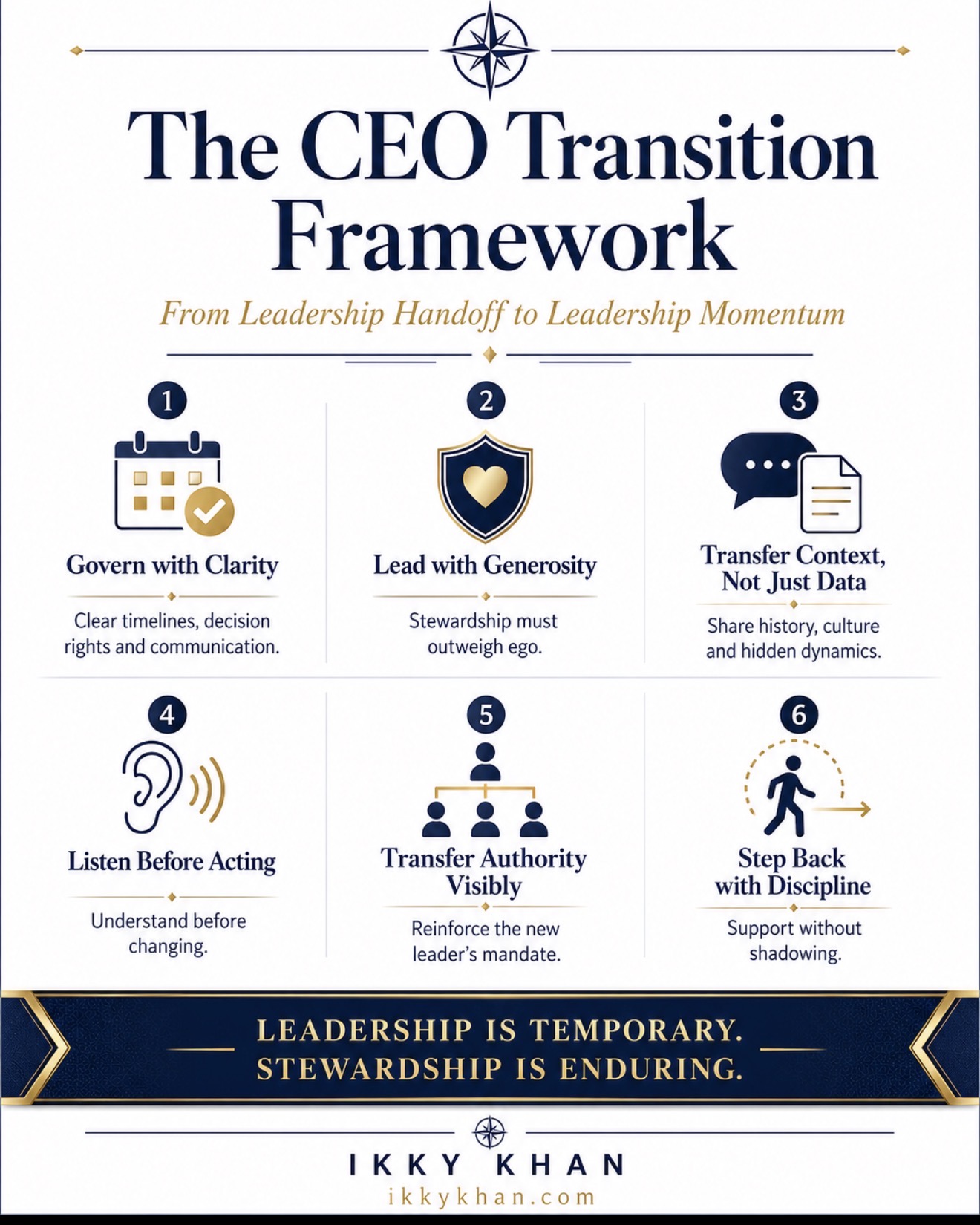
A strong transition starts the moment a departure becomes known. From that point, the Board must govern the process with clarity and discipline.
What decisions remain with the outgoing CEO? When does authority begin to shift? Which stakeholders require early engagement? How will the organisation communicate stability without signalling stagnation?
Ambiguity is dangerous. Employees need to know who is accountable. Executives need clarity on decision rights. External stakeholders need reassurance that the organisation remains focused and well governed.
Succession should therefore be treated as a structured governance process, not an informal arrangement between two leaders. Clear timelines, defined responsibilities and a unified communication approach prevent confusion and competing centres of influence.
Stewardship must outweigh ego
The outgoing CEO carries a unique responsibility. The temptation to protect a legacy, defend past decisions or shape the successor’s agenda is understandable. However, the role of the departing leader is not to preserve influence, but to create the conditions in which the next CEO can succeed.
That requires honesty, generosity and perspective.
It means sharing achievements and unfinished work, explaining where relationships are strong or fragile, identifying unresolved risks and being candid about which assumptions may no longer hold.
The final act of leadership is not extending your shadow. It is ensuring your successor no longer needs it.
Context matters as much as information
Most handovers are rich in data and poor in context.
Reports show performance. Board papers document decisions. Budgets reveal priorities. Risk registers outline exposure. But none fully explains why the organisation arrived where it did.
The incoming CEO needs to understand the history behind major decisions, the cultural dynamics within the executive team, stakeholder sensitivities and the informal networks that shape how work gets done.
They need to know which issues appear operational but are fundamentally cultural, where fatigue exists and where silence may be masking deeper concern.
This is the value only the departing CEO can provide: insight that no document can fully capture.
The successor must listen before acting
A successful transition also depends on the judgement of the incoming CEO.
New leaders often feel pressure to demonstrate momentum quickly. They may be expected to make visible decisions, establish a new direction or signal that a different era has begun. But speed without understanding can damage what should have been preserved.
The incoming CEO must listen before judging, understand before changing and distinguish between practices that are merely inherited and those that remain valuable. Their first responsibility is not to prove that they are different. It is to understand the organisation they have been entrusted to lead.
This does not mean delaying necessary change. It means ensuring that change is informed by context rather than impatience.
Authority must transfer visibly
One of the greatest risks in any CEO transition is that the title transfers before the authority does.
Employees may continue to seek reassurance from the outgoing leader. Executives may delay difficult decisions. External stakeholders may rely on established relationships rather than engaging directly with the successor.
If this persists, the new CEO inherits the role without fully inheriting the organisation.
Authority must therefore transfer visibly and deliberately. The outgoing CEO should direct questions and decisions to the successor. The Board should reinforce the new leader’s mandate. Senior executives should demonstrate alignment through their conduct.
This does not require the outgoing CEO to disappear abruptly. It requires them to step back with discipline.
A transition succeeds when people begin looking forward rather than continuing to look back.
Support must not become shadowing
The incoming CEO should be supported, but not shadowed.
Access to the outgoing leader can be valuable where historical context, stakeholder introductions or unresolved matters require continuity. But that support must have boundaries.
The successor needs space to form independent judgements, build direct relationships and establish a leadership identity of their own. They must be free to question established practices without feeling that they are challenging the person who introduced them.
No two CEOs will lead in the same way. Nor should they. A strong transition preserves what is valuable while making room for what must evolve.
The true measure is what happens next
The success of a CEO transition is not measured by the farewell, the handover document or the praise given to the departing leader. It is measured by what happens afterwards.
Does the organisation retain confidence? Do key relationships remain strong? Does the executive team stay aligned? Are risks understood? Can the new CEO make decisions with authority? Does the organisation maintain momentum while adapting to a new leadership style?
These are the outcomes that matter.
Leadership is temporary. Stewardship is enduring.
The strongest CEOs understand that their responsibility is not only to lead well while in office, but also to leave the organisation capable of succeeding after they have gone.
That may be the final test of leadership, and one of the most important.